Form 430 for Jue Wing Chung - Application of Alleged American Citizen of the Chinese Race for Preinvestigation of Status, 1921
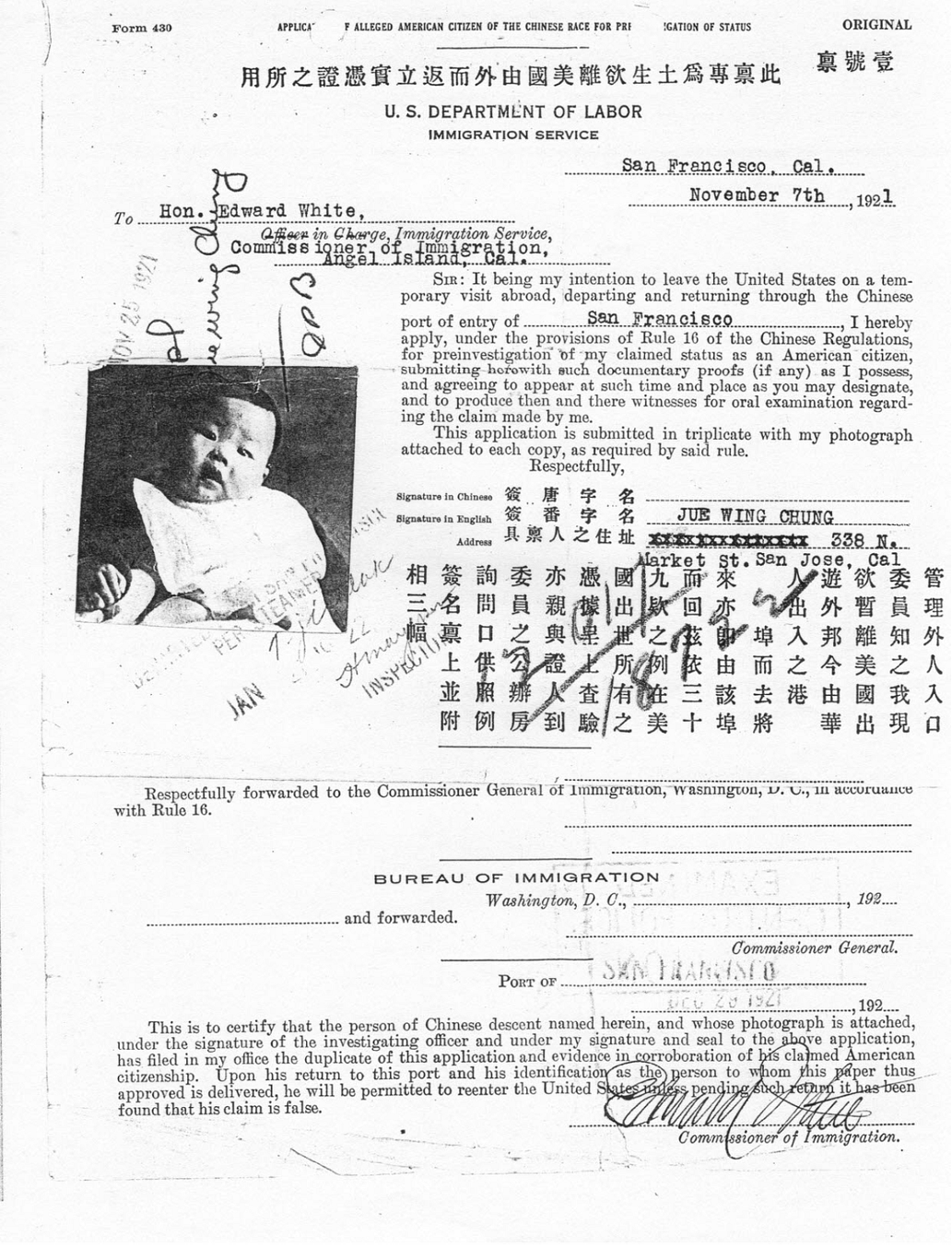
Form 430 for JUE Wing Chung - Application of Alleged American Citizen of the Chinese Race for Preinvestigation of Status, 1921. From case file 34163/4-2 for JUE Wing Chung. Immigration Arrival Investigation Case Files, 1884–1944. Records of the San Francisco District Office of the Immigration and Naturalization Service. Record Group 85. National Archives at San Francisco.
URL: https://catalog.archives.gov/id/28880553 (not digitized on NARA catalog, image provided by Chris Chow)
Please read a reflection on this document by Chris Chow, an Emmy award winning journalist and filmmaker who helped save the Angel Island U.S. Immigration Station from demolition in the 1970s and transform it into a National Historic Landmark and Visitor Center. Chow also helped save the National Archives at San Francisco/San Bruno when it was threatened with closure in 1998, as a member of Save OUR National Archives. Now, 28 years later, SONA is working again to stop the closure of the National Archives at San Francisco, this time a secretive move under President Trump.
The earliest picture we have of my father James Wing Chow are at the National Archives and Records Administration (NARA) at San Francisco inside the Leo J. Ryan Memorial Federal Building in San Bruno, CA.
No one in our family had ever seen or known of this until 1998 when my sister Stephanie King found it in his immigration file there. He was not an immigrant but a U.S.-born citizen, treated as an immigrant because of the Chinese Exclusion Act.
The picture was of him as a baby, a few months after he was born in San Jose, California, May 12,1921. His name then was Jue Wing Chung.
It’s a photo taken for his Form 430, a document needed in the process to prove his status as a native-born U.S. citizen upon his later return to his homeland. The form was known as the “Application of Alleged American-Born Chinese for Pre-Investigation of Status.”
My father’s file in the National Archives at San Bruno is part of the historical record of America, his homeland and my country too. Today, it and many other historical records of individuals, families, and institutions in the Western part of the United States are still available and accessible to the public there.
But the Trump Administration has moved to close off such public access to history.
The National Archives and Records Administration (NARA) through its Acting Archivist of the United States, Mr. Edward Forst, an appointee of President Trump, has ordered the closure of the Chicago and San Francisco (San Bruno) National Archives regional centers, with removal of holdings beginning as soon as this month. This was disclosed not in a public announcement nor with any public discussion but in a June memo to all employees of NARA by the chief of operations, Jay Trainer, that was anonymously leaked.
The impending loss of physical access to my father’s and other family members’ files at NARA San Francisco/San Bruno is a great blow to us. And here’s why:
The Form 430 document and photo on it were entered into the record of a Board of Special Inquiry convened at the Angel Island Immigration Station in July, 1934.
When my father came back to the United States at the age of 13, he needed to prove his right of entry as a birthright citizen. Also entered into the record was the above sworn deposition by his father Jue Shin with photos of them both.
His case was considered at Angel Island by a Board of Special Inquiry comprised of three commissioners who were to weigh documentary evidence and interrogate the applicant and vouching witnesses and compare photographs of the applicant with the in-person appearance of the subject applicant in reaching a verdict. In my father’s case he was unanimously admitted, though with caveats regarding photo identification, as evidenced by the Board of Special Inquiry’s hearing transcript and a summary by Chairman F. Arnold.
One discerning comment of the board was that “he seemed to testify frankly and with the desire to give complete information.” I think this points to one of his character traits because one of Dad’s favorite proverbs was “honesty is the best policy.” It was a constant admonition to us children.
To the extent that he lived, James Wing Chow experienced the good and the bad, the ugly and the beautiful, the exclusions and opportunities, of the American Dream.
Were my sister not able to retrieve these records of our father and hold them in her hands and share them with me, our families would not know nor understand the scope of his journey nor the depth of his courage in grasping the American Dream. He achieved much of it. And may we build upon it and upon his shoulders. We can do so by keeping these records here at NARA San Francisco/San Bruno, accessible to members of the public and other heirs of history .